
Publications
Collaborative output
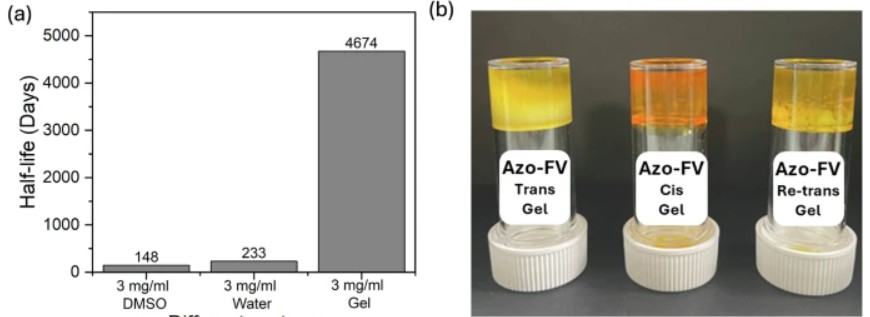
Functionalized Azobenzenes for Micellar Solar Thermal Energy Storage as a Next-Generation MOST System
This work introduces a micellar solar thermal energy storage (MIST) approach that traps azobenzene-based photoswitches within self-assembled environments to dramatically extend energy storage lifetimes.
Huang, R.; Loch, A. S.; Pincham, A.; Smith, A. J.; Seddon, A.; Wang, Z.; Adams, D. J. Communications Chemistry, 2025, 8, 369.
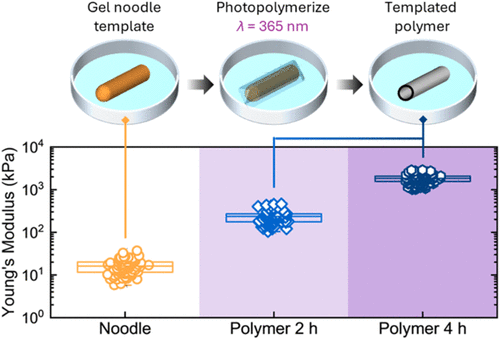
Supramolecular Benzophenone-Based Photoinitiator for Spatially-Resolved Polymerization
This work presents a new approach to spatially control polymerisation by localising benzophenone-based photoinitiators within self-assembled dipeptide gel noodles, ultimately enabling the formation of complex polymeric structures.
Loch, A. S.; Mikhail, I.; Bianco, S.; Ghosh, D.; Sonani, R. R., Chechik, V., Vassalli, M.; Egelman, E. H., Smith, A. J.; Adams, D. J. ACS Applied Materials & Interfaces, 2025, 17, 20, 30297-30305
Collaborative output

Predicting the Mechanical Properties of Supramolecular Gels
Predicting gelation is challenging as current models focus on whether a gel will form rather than its properties, which are crucial for specific applications. This work presents the first successful a priori prediction of gel properties in self-assembled supramolecular systems, addressing this critical gap.
Simpson, J. D., Thomson, L., Woodley, C. M., Wallace, C. M., Dietrich, B., Loch, A. S., Adams, D. J., Berry, N. G. Advanced Materials, 2025, 2415031
Collaborative output
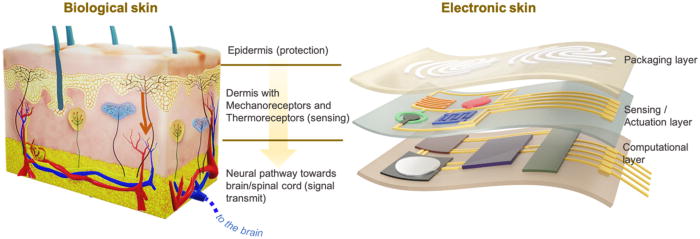
Printing Semiconductor-based Devices and Circuits for Flexible Electronic Skin
Electronic skin (e-skin) integrates advanced sensors to detect stimuli and is vital in areas like healthcare, robotics, and wearables, with low-cost fabrication being key. This review explores innovations in printing high-quality electronic layers using inorganic nanostructures and highlights the challenges and solutions for scalable, high-resolution printing.
Dahiya, A. S., Zumeit, A., Christou, A., Loch, A. S., Purushothaman, B., Skabara, P. J., Dahiya, R. Applied Physics Reviews 2024, 11, 041334
Collaborative output
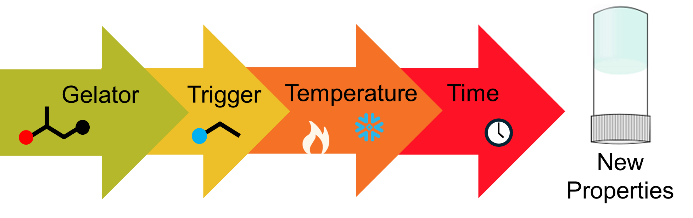
Designing and Controlling Transient Supramolecular Gels
This study demonstrates how varying triggers and temperatures influence the mechanical properties and transitions in transient systems, providing insights into the long-term evolution of supramolecular gels beyond typical analysis periods.
Bowley, E., Bianco, S., Hallam Stewart, F., Wallace, C., Ginesi, R., Loch, A. S., Rosenthal, M., Smith, A. & Adams, D. J. ChemSystemsChem 2024, e202400073

Fluorescence-Based Detector Design Principles for Low Vapor Pressure Analytes
Fluorescence-based sensing offers a way to detect trace amounts of chemicals, including low-volatility drug salts. This study describes a testing platform with a swab heating unit and optimized sensing chamber to enhance detection sensitivity. The platform detects small quantities of illicit drug salts like MDA, cocaine, fentanyl, and methamphetamine by using fluorescence quenching and can detect as little as 30 ng of the substance.
Loch, A. S.; Burn, P. L.; Shaw, P. E. Advanced Sensor Research 2024, 2400092
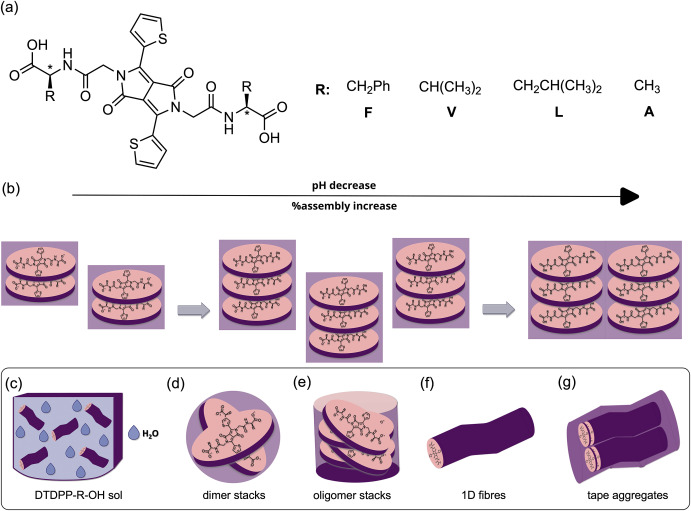
Controlling Aggregation of Diketopyrrolopyrroles in Water
Charge repulsion can be used to control the supramolecular aggregation of amino acid-substituted diketopyrrolopyrroles in water, leading to distinct aggregation states with different photophysical properties. This simple approach allows for tuning optical gaps, electroactivity, and exciton binding energies, expanding the absorbance range and creating systems with large Stokes shifts without the need for extensive synthetic optimisation.
V. Gauci, A. S. Loch, D. McDowall, C. Edwards-Gayle and D. J. Adams, Dyes and Pigments, 2024, 223, 111968.
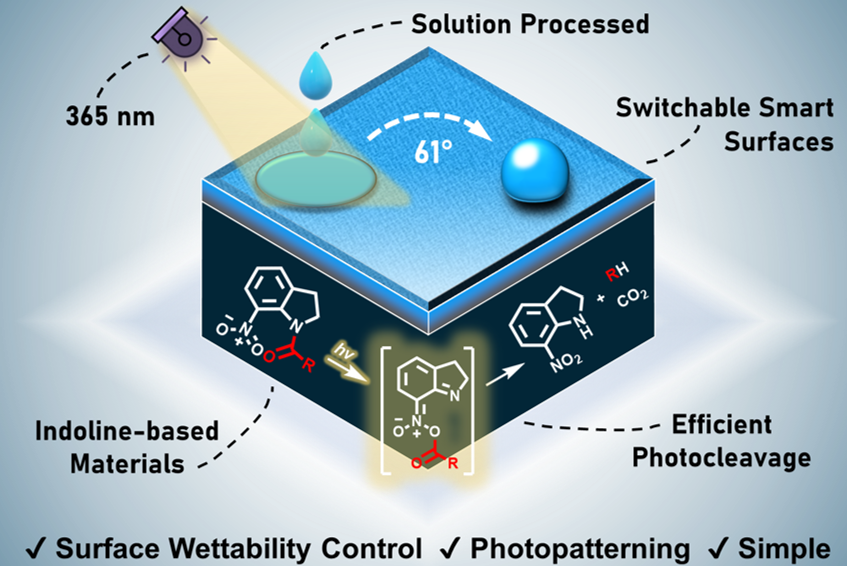
Simple Photocleavable Indoline-based Materials for Surface Wettability Patterning
There is growing interest in smart surfaces that can switch between hydrophobic and hydrophilic states on demand, with light-activated surfaces being especially attractive for remote control of wettability and water channeling. Here, we introduce a simple approach using indoline-based small molecules to control surface wettability with UV light, achieving significant water contact angle changes and demonstrating their effectiveness for smart surface applications.
Loch, A. S.; Cameron, D.; Martin, R. W.; Skabara, P. J.; Adams, D. J. Material Advances 2024, 5 (2), 741–748.
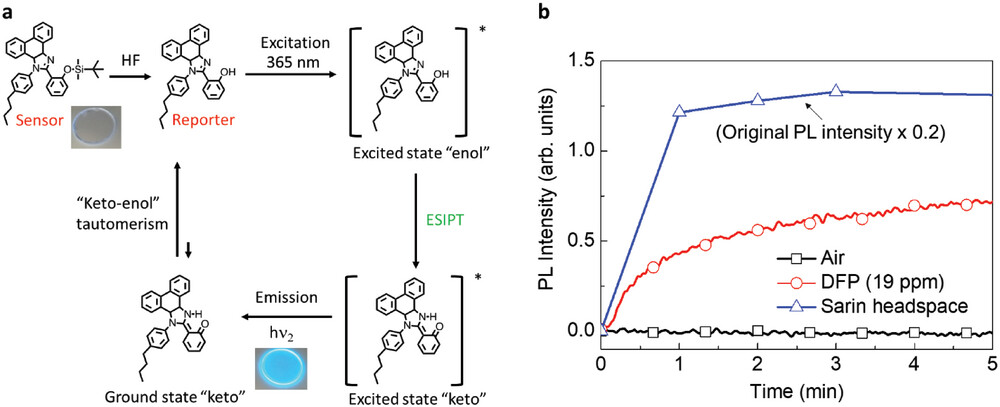
Differentiating Between V- and G-Series Nerve Agent and Simulant Vapours Using Fluorescent Film Responses
Rapid and reliable in-field identification of nerve agents is crucial for the protection of defence personnel and first responders. A fluorescence-based method is introduced that differentiates between V-series and G-series nerve agents, avoiding false positives from common acids by using two distinct detection mechanisms: photoinduced hole transfer for V-series detection and a turn-on mechanism triggered by hydrogen fluoride for G-series detection.
Fan, S.; Loch, A. S.; Vongsanga, K.; Dennison, G. H.; Burn, P. L.; Gentle, I. R.; Shaw, P. E. Small Methods 2024, 8 (1).

Fluorescent Sensors for the Detection of Free-base Illicit Drugs – Effect of Tuning the Electronic Properties
Fluorescence-based detection of chemical vapors is valuable for portable, low-power devices, but traditional methods using electron transfer are ineffective for compounds with low electron affinities, such as illicit drugs. This study presents four compounds with large ionization potentials capable of detecting free-base drugs via photoinduced hole transfer, with thin films of these materials showing selective detection of drugs like fentanyl, cocaine, and methamphetamine, providing a method for discriminating between them.
Loch, A. S.; Burn, P. L.; Shaw, P. E. Sensors and Actuators B: Chemical 2023, 387, 133766.
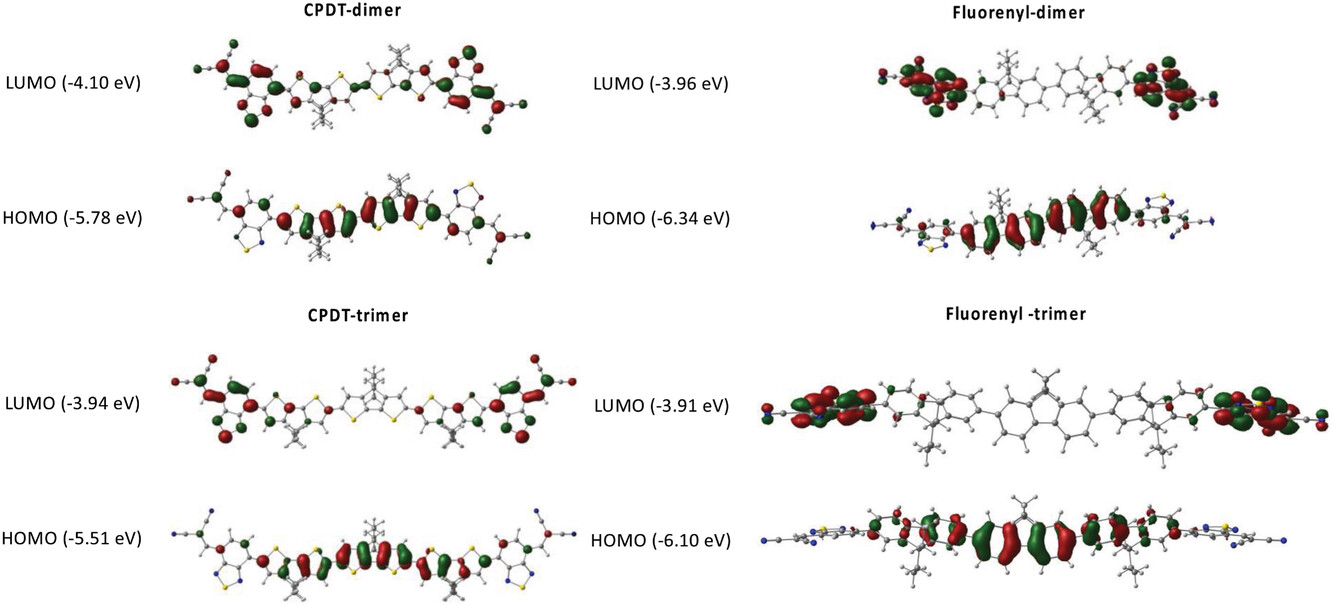
Dielectric Constant Engineering of Organic Semiconductors: Effect of Planarity and Conjugation Length
Single-component organic solar cells are appealing due to simpler manufacturing. This study explores factors affecting the dielectric constant of these cells, finding that chromophore planarity, film density, and molecular orbital delocalization play critical roles. The dimer containing two dicyanovinylbenzothiadiazole and two dithienocyclopentadiene units exhibited the highest dielectric constant and performance.
Jiang, W.; Jin, H.; Babazadeh, M.; Loch, A. S.; Raynor, A.; Mallo, N.; Huang, D. M.; Jiao, X.; Tan, W. L.; McNeill, C. R.; Burn, P. L.; Shaw, P. E. Advanced Functional Materials 2022, 32 (3).
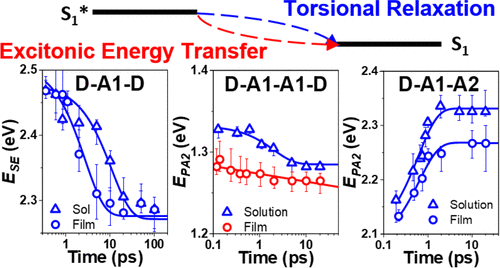
Determining the Correlation between Excited State Dynamics and Donor and Acceptor Structure in Nonfullerene Acceptors
The design of nonfullerene acceptors (NFAs) has significantly improved organic photovoltaic (OPV) performance, but fewer studies have focused on their excited-state photophysics. This study uses femtosecond transient absorption spectroscopy and time-resolved photoluminescence to investigate three NFAs, revealing that torsional relaxation and resonant excitonic energy transfer influence singlet exciton relaxation, with reduced nonradiative decay and increased photoluminescence quantum yields contributing to better OPV performance.
Zhang, G.; Loch, A. S.; Babazadeh, M.; Burn, P. L.; Shaw, P. E. The Journal of Physical Chemistry C 2020, 124 (33), 17851–17863.
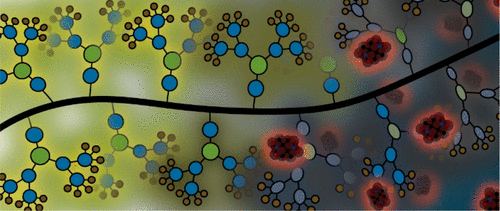
High-Sensitivity Poly(dendrimer)-Based Sensors for the Detection of Explosives and Taggant Vapors
Poly(dendrimers) are a promising class of fluorescent organic semiconductors for detecting nitro-based explosives and taggants. This study demonstrates their rapid and sensitive detection of DMNB, a challenging-to-detect taggant, using fluorescence quenching, while also showing selectivity against common household interferents.
Loch, A. S.; Stoltzfus, D. M.; Burn, P. L.; Shaw, P. E. Macromolecules 2020, 53 (5), 1652–1664.
Selected for the article cover.

Dicyanovinyl-based fluorescent sensors for dual mechanism amine sensing
Food wastage due to spoilage is a significant global issue, and smart packaging with responsive sensors offers a solution by providing real-time monitoring of food freshness. This study presents two fluorescent compounds, K12 and K12b, which rapidly detect biogenic amines via color change and fluorescence modulation, enabling dual-sensor arrays for sensitive detection of amine vapors.
Zhang, G.; Loch, A. S.; Kistemaker, J. C. M.; Burn, P. L.; Shaw, P. E. Journal of Materials Chemistry C 2020, 8 (39), 13723–13732.
Selected to be a part of the 10th Anniversary: Dedicated Authors theme.
 Loch Group